Trainer for AI in the Supply Chain

Demand forecasting, inventory optimization and agentic AI – clear, quantitative and practical.

Dr. Jan Fränkle

Dr. Jan Fränkle

About me

I am a physicist and hold a doctorate in economics, and I have been developing AI solutions for the supply chain for more than 20 years – today increasingly with agentic AI. What drives me is the question of how to make good decisions when the future is uncertain. As a trainer I do not want to talk about AI. I want to show what it actually does in the everyday work of planning and replenishment, and where its limits lie. What pleases me most is the moment when participants recognise the potential in their own company.

Seminar topics

AI-Supported Replenishment Planning

2 days

How the forecast, the safety stock and the replenishment decision fit together, and where AI actually improves classical replenishment. With worked examples and live demos in which participants replenish for themselves.

For: Replenishment planners, material planners, supply chain leads

Demand Forecasting in Practice

1 day

A forecast is a distribution, not a single value. We look at how to measure forecast quality properly, and which metrics lead you astray.

For: Demand planners, S&OP leads, controlling

Agentic AI in the Supply Chain

1 day

AI agents can already take on parts of planning and procurement. We look at where they fail, and how to bound a first deployment sensibly.

For: Supply chain leaders, heads of digitalisation

AI Fundamentals for Supply Chain Leaders

½ to 1 day

A sober overview of what machine learning can do and what it cannot. This includes how to judge AI promises from vendors.

For: Decision-makers without a technical background

I also offer every topic as in-house training, adapted to the company's industry and data.

How I teach

In my seminars, participants calculate for themselves instead of reading slides. I work with interactive demos in the browser. You change a safety stock, for example, and immediately see what happens to availability and inventory. The same logic applies to the forecast: a distribution can be shifted, and the consequences for the replenishment decision become visible at once.

In between there are small competitions. Who replenishes a simulated season best? We look at the result together. The point is to retrace one's own decisions.

I make typical errors of reasoning tangible before I explain them. A higher safety factor does not bring a linear gain in availability. MAPE can make a forecast look good that is of little use for replenishment.

Every seminar ends with the question of what can be put into practice in one's own company. There are also detailed handouts to read afterwards.

A look inside

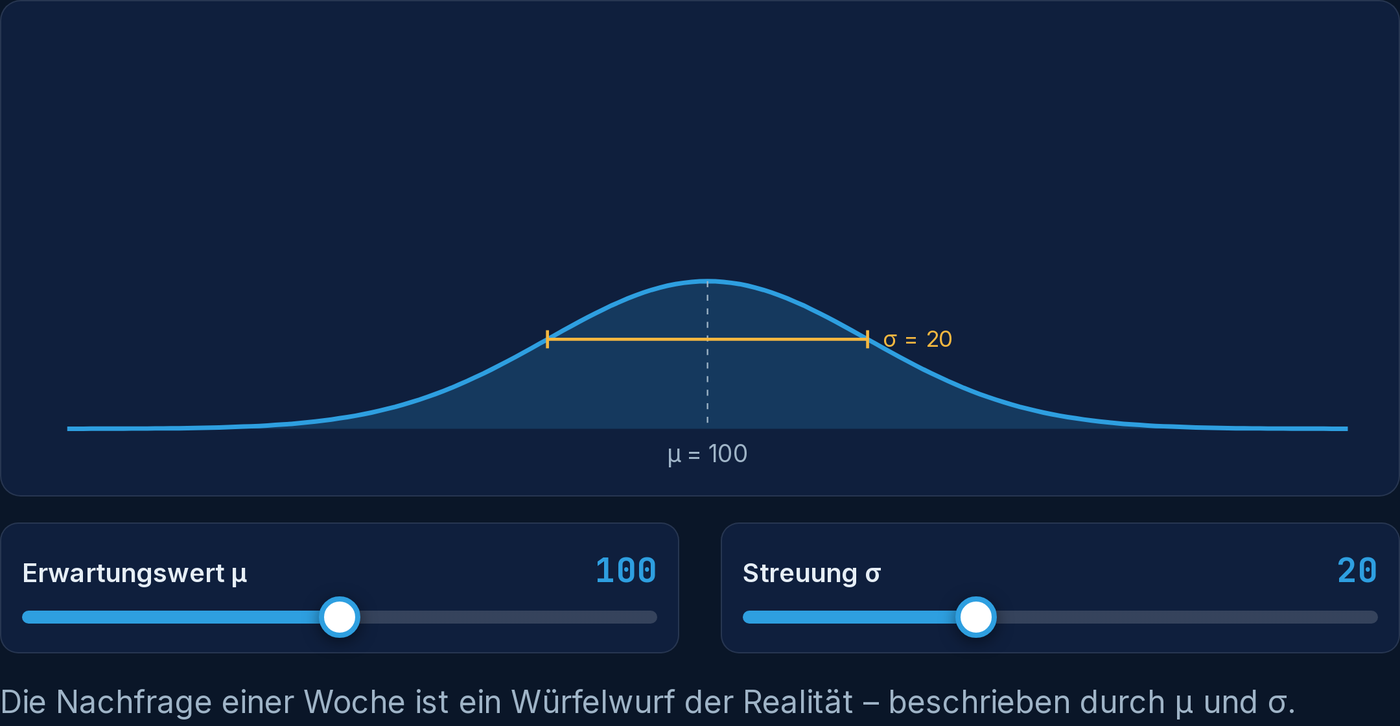
Distribution demo with a bell curve, mean and spread
Demand as a distribution: mean and spread can be shifted in the demo.
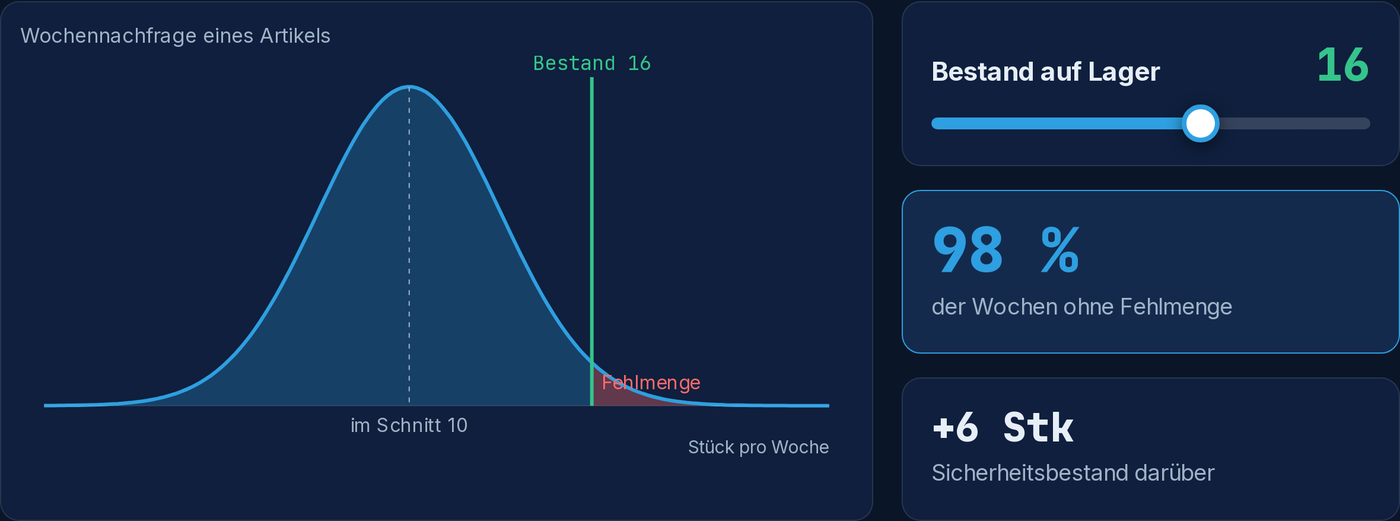
Slider for stock on hand, with the share of weeks without a stockout
The slider sets the stock on hand, and the shaded area shows the share of weeks without a stockout.
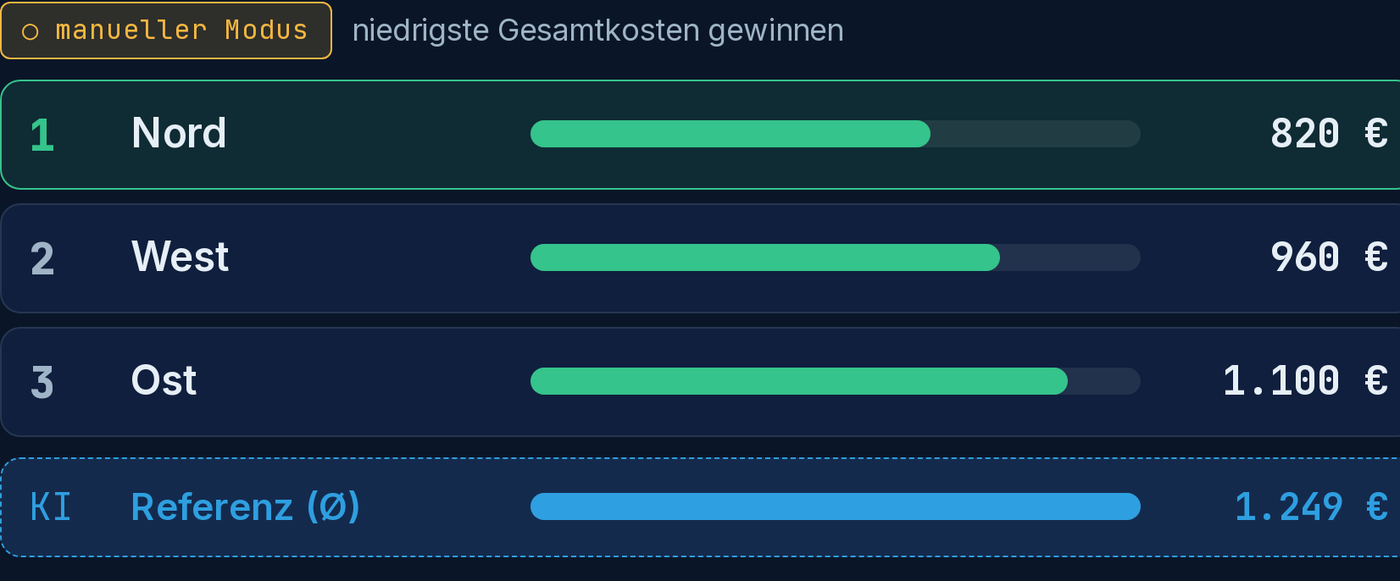
Ranking after a simulated replenishment season
Ranking after a simulated season in which participants replenish against each other.

How to calculate a safety stock

Formats

  • In person (DACH)
  • Live online
  • In-house
  • Languages: German, English

Background

  • Degree in physics
  • Doctorate in economics (Dr. rer. pol.), KIT Karlsruhe
  • More than 20 years developing AI solutions for forecasting and inventory optimization
  • Managing director of ITM-predictive GmbH (Karlsruhe) and ITM-predictive Suisse GmbH

Contact

Email: jan.fraenkle@itm-p.ch

Arrange a meeting

LinkedIn: [LINKEDIN-URL]